


ITEM SPECIFICATIONS
* Name/Type: Lukwakongo mask (traditionally used as an initiation object within the Bwami society)
* Ethnic Group: Lega people (primarily located in the Democratic Republic of the Congo)
* Height: 23 cm (approximately 9.06 inches)
KEY IDENTIFYING FEATURES & STYLE ANALYSIS
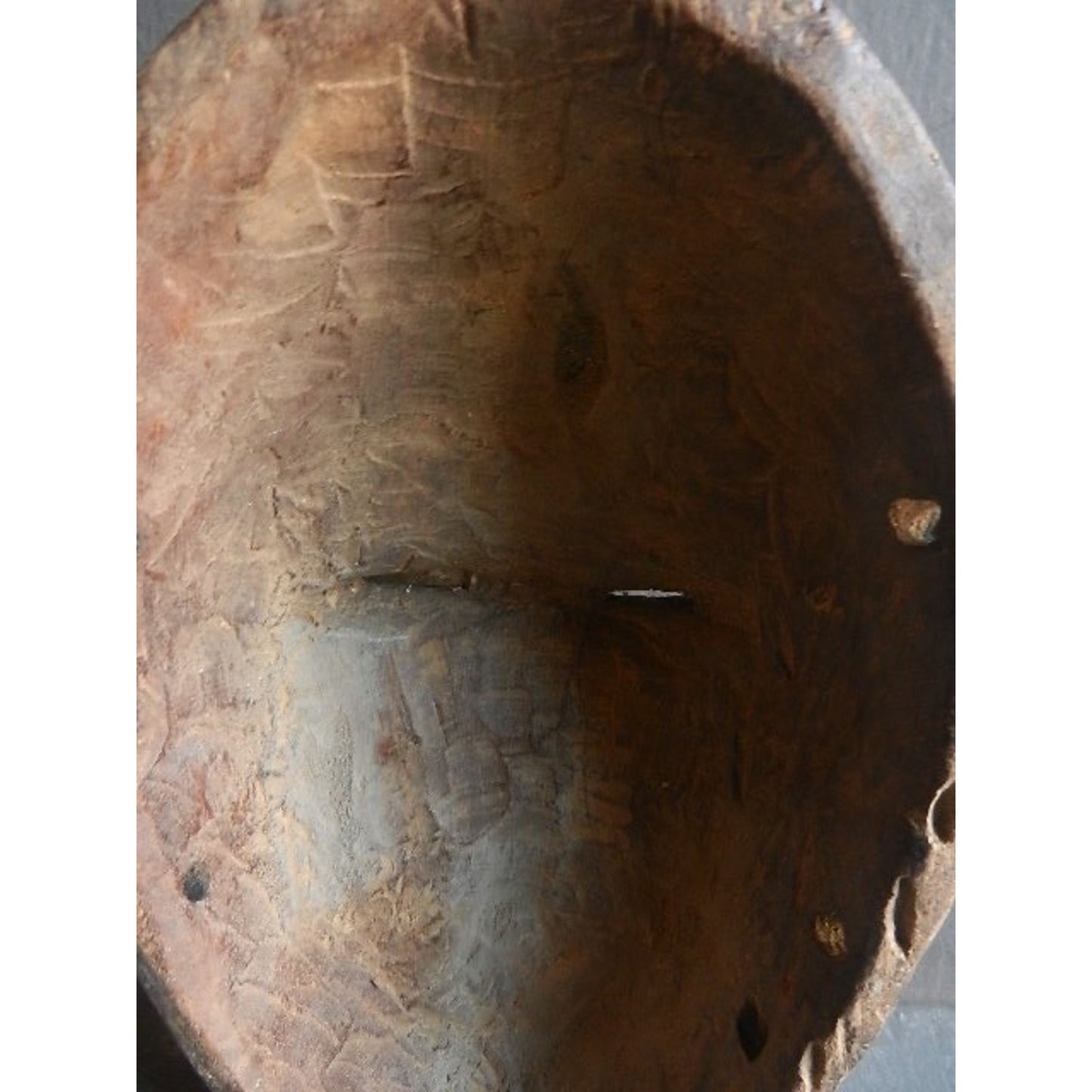
This mask represents a classic and exemplary piece of traditional Lega craftsmanship. It can be identified by several distinct, highly significant stylistic choices:
* Heart-Shaped, Concave Face: The most prominent hallmark of Lega masks is the deeply scooped, inward-curving facial plane that creates a distinct heart shape.
* Coffee-Bean Eyes: These highly stylized, protruding eyes feature horizontal slits. Within the Bwami society, this classic feature is utilized to signify inner sight and heightened spiritual awareness.
* Pointed Apex: The top of the mask tapers upward, terminating in a very distinct point or peak.
* Prominent Nose: A long, narrow nose extends smoothly and continuously from the arch of the brow line down through the center of the face.
* Pierced Chin: A functional detail consisting of a small hole visible at the very bottom edge. While these masks rarely feature carved mouths, this specific hole is traditionally used to attach a long, cascading beard crafted from woven raffia fiber (please note that the raffia beard is missing from this particular piece).
CULTURAL CONTEXT & TRADITIONAL USE
Unlike ritual masks found in many other African cultures, Lega Lukwakongo masks were rarely worn directly over the face. Instead, their ceremonial role was dynamic: they were frequently held in the hand, attached onto hats, or hung directly on fences during important Bwami society initiation ceremonies.
Track Page Views With
Auctiva's Counter
* Name/Type: Lukwakongo mask (traditionally used as an initiation object within the Bwami society)
* Ethnic Group: Lega people (primarily located in the Democratic Republic of the Congo)
* Height: 23 cm (approximately 9.06 inches)
KEY IDENTIFYING FEATURES & STYLE ANALYSIS
This mask represents a classic and exemplary piece of traditional Lega craftsmanship. It can be identified by several distinct, highly significant stylistic choices:
* Heart-Shaped, Concave Face: The most prominent hallmark of Lega masks is the deeply scooped, inward-curving facial plane that creates a distinct heart shape.
* Coffee-Bean Eyes: These highly stylized, protruding eyes feature horizontal slits. Within the Bwami society, this classic feature is utilized to signify inner sight and heightened spiritual awareness.
* Pointed Apex: The top of the mask tapers upward, terminating in a very distinct point or peak.
* Prominent Nose: A long, narrow nose extends smoothly and continuously from the arch of the brow line down through the center of the face.
* Pierced Chin: A functional detail consisting of a small hole visible at the very bottom edge. While these masks rarely feature carved mouths, this specific hole is traditionally used to attach a long, cascading beard crafted from woven raffia fiber (please note that the raffia beard is missing from this particular piece).
CULTURAL CONTEXT & TRADITIONAL USE
Unlike ritual masks found in many other African cultures, Lega Lukwakongo masks were rarely worn directly over the face. Instead, their ceremonial role was dynamic: they were frequently held in the hand, attached onto hats, or hung directly on fences during important Bwami society initiation ceremonies.
Track Page Views With
Auctiva's Counter