


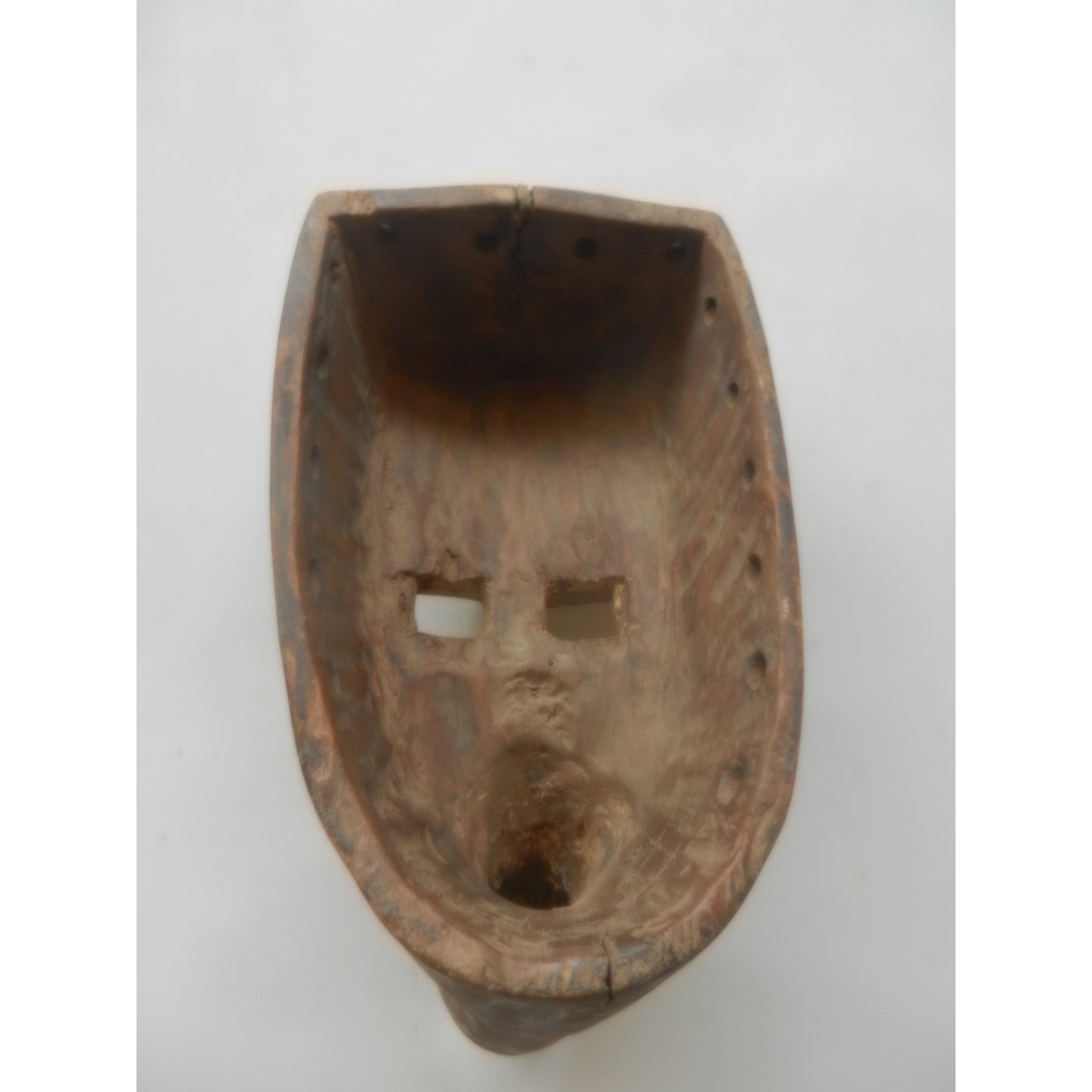
- Origin: Guinea–Liberia border region — Toma (Loma) peoples, possibly related Bassa tradition
- Material: Hand-carved wood, worn natural patina with lighter wear at raised planes
- Type: Helmet mask (worn over the head rather than in front of the face)
- Dimensions: 25 x 10 cm
- Condition: Stable surface with age-consistent wear; small losses/wear at ear flanges; interior mouth cavity shows deep wear from use — recommend requesting additional photos or in-person inspection for full condition detail
About this piece:
A striking helmet-form mask carved from a single piece of wood, built around a strongly elongated, tapering silhouette. The crown rises to a smooth, domed cap ringed with a row of small drilled perforations — likely used to attach a fiber, raffia, or cloth fringe that would have framed the wearer's head during performance. Small lateral flanges just below the crown suggest stylized ears. The face is minimal and abstracted: two square-cut eye openings sit beneath the cap's rim, while the lower two-thirds of the mask tapers into a long, cylindrical, tube-like mouth projecting forward — a dramatic sculptural feature that would have amplified the wearer's voice or vocalizations during ritual performance, a functional as well as symbolic element common to helmet masks of this type. The overall form is highly reductive and architectural rather than naturalistic, typical of the forest-region masking styles of this part of West Africa.
Cultural Significance
Helmet masks with elongated, tube-mouthed forms from the Toma (Loma) and related Guinea–Liberia forest traditions are associated with Poro society initiation and secret-society ritual life, paralleling related traditions among neighboring Guéré, Kran, and Bassa peoples. Worn fully over the head rather than in front of the face, such masks often embodied powerful nature or bush spirits, and their exaggerated, abstracted forms were meant to render the wearer unmistakably non-human during performance — reinforcing the mask's role as a vessel for spiritual authority rather than individual identity. The tubular mouth in particular may have served to disguise or distort the wearer's voice, adding to the mask's supernatural presence during ceremonies tied to initiation, judicial authority, or protective ritual.
Notes for Collectors
Attribution to Toma/Loma vs. a closely related Bassa tradition reflects stylistic comparison; buyers wanting certified provenance should consult a specialist in Guinea–Liberia forest-region masking traditions.
Recommended care: store away from direct sunlight and high humidity; the tube-mouth cavity may collect dust and should be cleaned gently with a soft, dry brush only.
- Material: Hand-carved wood, worn natural patina with lighter wear at raised planes
- Type: Helmet mask (worn over the head rather than in front of the face)
- Dimensions: 25 x 10 cm
- Condition: Stable surface with age-consistent wear; small losses/wear at ear flanges; interior mouth cavity shows deep wear from use — recommend requesting additional photos or in-person inspection for full condition detail
About this piece:
A striking helmet-form mask carved from a single piece of wood, built around a strongly elongated, tapering silhouette. The crown rises to a smooth, domed cap ringed with a row of small drilled perforations — likely used to attach a fiber, raffia, or cloth fringe that would have framed the wearer's head during performance. Small lateral flanges just below the crown suggest stylized ears. The face is minimal and abstracted: two square-cut eye openings sit beneath the cap's rim, while the lower two-thirds of the mask tapers into a long, cylindrical, tube-like mouth projecting forward — a dramatic sculptural feature that would have amplified the wearer's voice or vocalizations during ritual performance, a functional as well as symbolic element common to helmet masks of this type. The overall form is highly reductive and architectural rather than naturalistic, typical of the forest-region masking styles of this part of West Africa.
Cultural Significance
Helmet masks with elongated, tube-mouthed forms from the Toma (Loma) and related Guinea–Liberia forest traditions are associated with Poro society initiation and secret-society ritual life, paralleling related traditions among neighboring Guéré, Kran, and Bassa peoples. Worn fully over the head rather than in front of the face, such masks often embodied powerful nature or bush spirits, and their exaggerated, abstracted forms were meant to render the wearer unmistakably non-human during performance — reinforcing the mask's role as a vessel for spiritual authority rather than individual identity. The tubular mouth in particular may have served to disguise or distort the wearer's voice, adding to the mask's supernatural presence during ceremonies tied to initiation, judicial authority, or protective ritual.
Notes for Collectors
Attribution to Toma/Loma vs. a closely related Bassa tradition reflects stylistic comparison; buyers wanting certified provenance should consult a specialist in Guinea–Liberia forest-region masking traditions.
Recommended care: store away from direct sunlight and high humidity; the tube-mouth cavity may collect dust and should be cleaned gently with a soft, dry brush only.